
making them earn everything, having good management and setting your dog up to succeed.
I believe every dog should be trained using balanced dog training ( my definition is teaching your dog first by using good management techniques, then once behaviors are well known holding your dog accountable for their actions.) Compare this to a child learning to ride a bike, first they have to want to know how to ride a bike (motivation), then we help steady them and also use training wheels, (management) then as they improve we stop holding on and take off the training wheels ( behavior is learned and now they are accountable.) The same is true when it comes to training a dog, you should motivate your dog to learn, use management techniques until the behavior is acquired, then hold your dog accountable for their actions.
During my initial consultations I frequently hear the following complaints; My dog jumps on people when they come over, my dog begs whenever we are eating, my dog jumps on the counter, my dog barks at everything outside, my dog pulls on walks and barks and lunges at other dogs, my dog won't come back when I call, my dog is wild in the house, my dog gets on the furniture and overall complaints of dogs that won't listen.
There are many answers to that question; lack of management, ( using leashes and dog crates in the house) lack of good training technique, lack of exercise, lack of leadership (not having the dog earn everything). In short we as owners are failing our dogs. The troubling aspect of this to me as a trainer is the fact that many people expect their dogs to be well behaved without putting in the time or effort.
I say this to every client and have written this before, DOGS DO NOT COME TO US WITH THE ABILITY TO UNDERSTAND HUMAN LANGUAGE, it is our job as pet owners to teach them what we want. When I discuss my philosophy of management and being prepared, many owners completely understand why this needs to occur, but feel like it is too much effort to put in. I don't bend on this topic, so many unwanted behaviors can be prevented before they ever occur this way.
In my opinion it is much easier to prevent unwanted behavior from occurring than it is too stop them once they are already there. The analogy I make here is like trying to lose weight.
For anyone who's ever tried to lose weight (which i believe is the majority of us) have you ever thought to yourself "man I wish I wouldn't have let myself get so out of shape, it would have been easier if I took care of myself better beforehand?" Now instead of watching what you eat and being a little more active you have to overhaul your life to stick to a diet and exercise. The point I'm driving at here is that it is much easier to start on the right path than it is to get lost and find your way back.
You will spend more time, effort and money if you don't do it right the first time anyway. The beautiful thing about dogs in this scenario that helps us, is that they are highly intelligent creatures. Because of that, a strict management routine doesn't need to last a lifetime. Dogs are creatures of habit much like us, which goes to show we can create both good and bad habits in them. I'd like to share the story of my own dog and the power of following the management until trained protocol.
Before I get to what I did as far as training goes, it is important to know his background and the situation he was brought into. This story starts in March of 2016, my wife and I had just moved into a condo in South Elgin and it was our first place alone together. My wife and I used to do some pet-sitting for a great local company ( Wild Things Pet Services) and one of her former clients had just brought home a Saint Bernard puppy and also owned a hairless cat named Monty.
The new puppy was very predatory towards Monty and was trying to hunt him every chance she got. I offered my training services to this client, but she went in another direction and long story short she decided to give up the cat. My wife jumped on this opportunity because she had become very close to Monty after caring for him for several years. So low and behold my first pet on my own was not the Doberman I had wanted since I was 12 it was a 14 yr old hairless cat lol.
Funny how life works out sometimes… On a side note, Monty is the coolest cat I've ever had the pleasure of knowing and we love him dearly. Fast forward to October of 2016 and I finally had enough of not having a dog, I always wanted a European bred Doberman puppy, but I didn't have the time for a puppy at this point in my life so I decided to rescue a dog that was just a little older and had some of the more time consuming issues puppies have behind them.
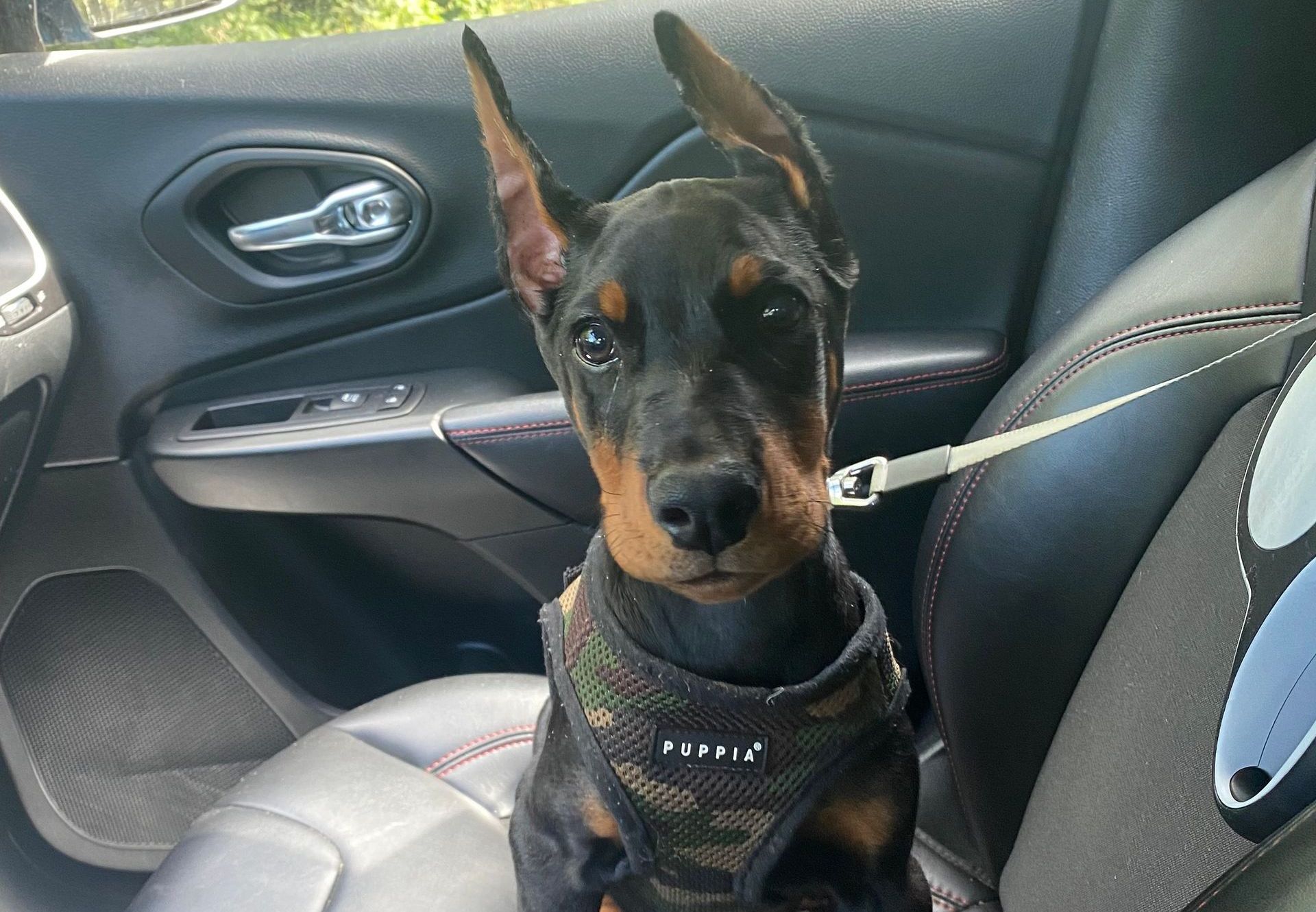
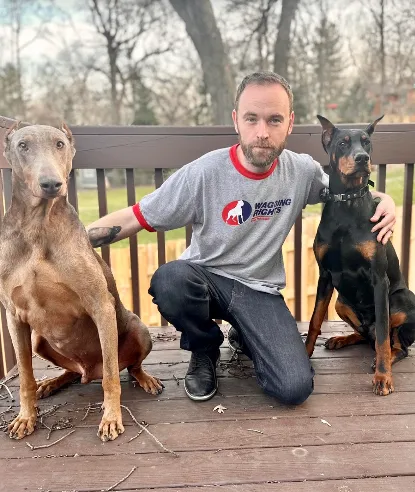
I searched all across the united states for a good fit and finally found Dalton a fawn 1 year old male Doberman at the Southwest Ohio Doberman rescue. We took a road trip out to meet him and because he was heart-worm positive we had to foster first and then adopt. When we got back home I immediately started my management until trained protocol. I kept Dalton on a leash and flat collar to begin with until I could condition him to a prong collar, the leash didn't leave my hand for several days unless he was crated.
I walked Dalton around his new home while Monty was gated off in our workout room. It is important to try get a dog comfortable in a new place first before immediately trying to get new pets to interact. Monty eventually came out from hiding to see his new brother, he was still behind the gate, but they started making eye contact from a distance. Right off the bat I never let Dalton fixate, I made kissy noises, tapped his flank and moved him away from the cat.
Quick tip aggression or reactivity starts with fixation, if you stop it there it won't escalate. Next I did role reversal, I put Dalton behind the gate and let Monty roam the house. I chose to use the gate because Dalton wasn't crate trained yet. Dalton fixated and barked a couple of times, but I was able to break his fixation by kicking the gate.
That was all for the first night, I would have done a bit more but I spent 12 hours driving that day to get Dalton and it was already time for bed by the time we got back. The next day with Monty gated in the workout room I started formally training Dalton, first teaching him our marker system. I use "yes" as a mark/release, "good" as a duration marker, "eh eh" as my try again/no reward marker and "no" as my correction marker.
I first taught "yes" and "good" through using food rewards and then started working on engagement training. I worked on this in 2 different ways and like both ways of doing it for various reasons. The first style of engagement training I borrowed from Michael Ellis. I began this process by saying "you ready" and proceeded to mark and reward any shred of attention Dalton was giving me. I started far away from Monty and worked my way towards Dalton's threshold which at the time was about 5 ft.