
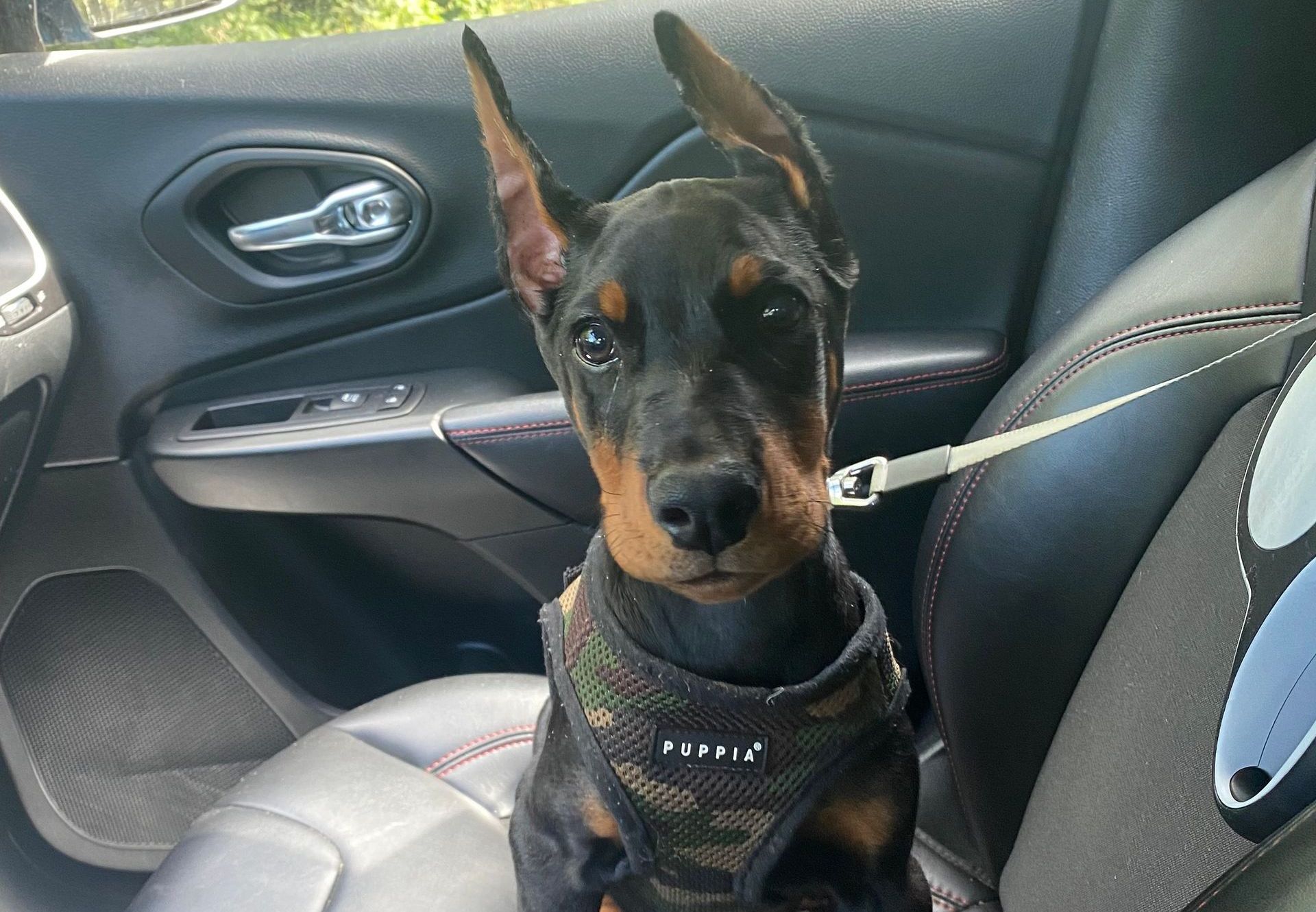
Potty training or house training a new dog can be challenging. Young puppies just can't hold it a very long time, dogs from shelters could be used to having accidents or be traumatized and dogs from pet stores can be used to going in their crates. Lets take a look at some steps to help eliminate accidents and completely potty train our dogs. Take your dog out the same door every time. This builds a routine and your dog will start going to this area when they need to go.
If you see any circling or sniffing, take your dog outside. Circling and sniffing are signs your dog has to go. Say something like "go potty" when you see your dog circling or sniffing outside, reward them with praise and sometimes food after they have went to the bathroom. Allow your dog access to food for 15 minutes. If they do not eat pick up the food and feed them at their next meal time. This is important for multiple reasons but for house training purposes it gives you a good idea when they are full.
If you free feed all day you will never know when your dog has to go. Take your dog out within 10 minutes after eating, drinking, sleeping and playing. Dogs are just like people, all of these activities can trigger going to the bathroom Limit food and water before bed. the amount of time depends on your dog. start with no food or water 3 hours before bed as they improve give them access to water a little longer. When you can not pay attention to your dog, use a dog crate. Dog crates simulate your dogs den instinct.
Dogs will be more likely to hold it if they are in close proximity to their own waste. An appropriate sized dog crate is just big enough for your dog to stand up and turn around. If your crate is too big your dog will still eliminate in it. Clean up any accidents with an enzymatic cleaner. Enzymatic cleaners destroy odors and prevent your dog from going in the same place again. Have your dog tethered to you or dragging a leash around the house.
This will help you keep an eye on your dog and also help establish your leadership role. If you catch your dog in the act say "no" and immediately bring them outside. If your dog is marking or really struggling with potty training you can correct them in the moment. I'd use an electronic collar for this. If you follow these steps your dog will be potty trained in no time. The new dog and the established dog. These are tricky waters to navigate for dog owners.
As with many scenarios in dog training the best of intentions can turn into a big problem in a hurry. Dog owners can just be trying to give their dog a friend or be trying to give their kids a younger more energetic dog as their current dog ages. The first mistake people make is assuming that their older dog is "nice" so there shouldn't be any issues. The second mistake is assuming it's the older dog's responsibility to deal with the new dog.
As with any interaction whether it's between two or more humans or two or more dogs the "nice" one can still be targeted. You can be the nicest person in the world and get stuck around a bully twice your size and have lots of problems. Or just be around someone who is very annoying to you and you just lose your patience. It always takes at least two to tango.
Now your new dog or puppy may not be trying to be mean, they could simply be over excited, have no off switch, not understand how to appropriately play yet etc. Your older dog can simply be telling your new dog to stop or to go away from them. Learn to read your dogs and learn when to step in. The vast majority of older dogs are not trying to seriously injure your new dog. Dogs use body language and different vocalizations to communicate with us and each other.
Most of the stuff that looks bad to the untrained eye in these situations are actually called agonistic behaviors which means behaviors used to create space between dogs that are annoying or potentially threatening. We should be seeing the signs before it gets to the point of air snapping, growling, showing teeth or biting though. We should step in and advocate for our older dog from day 1.
When you see your new dog demand barking at your older dog to play, jumping on your older dog, acting obsessed with your older dog, getting to close when your older dog is eating or chewing a bone etc you should be intervening before your older dog feels like they have to. I personally use spacial pressure, squirt bottles and dressage whips ( used as an extension of my arm, not as a whip) to separate dogs and provide space for my older dog.
It is also our job not our older dog's job to teach our new dog how to behave. Until you know your dogs are safe together I never suggest leaving them alone together. Always use crates, gates or exercise pens to keep them separated when they are unsupervised. Having both dogs obedience trained is crucial, but until they both respond well they need to be managed. Cues that are helpful in these situations are the place command, come when called, wait, boundaries and relaxation.
Most often we have to start with teaching our dogs to just learn how to exist around each other before they can learn to accept and like each other. Management is crucial in the beginning as well as having good things like small training sessions occur near each other and going on walks together. I also recommend picking up all toys and food dishes at least until the dogs become more comfortable with each other.
WORKING AT APPROPRIATE LEVELS The idea of being at a certain skill level and labeling it isn't a new concept. We obviously have different grade levels throughout school, different ranks in professional sports, different belt colors in martial arts and different ranks throughout corporate jobs. This concept as logical and common as it with humans is almost always completely lost when it comes to training our dogs.
In general what dog owners do to teach dogs to stop doing something is put them in a scenario they can't handle or are not ready for and then teach the dog a lesson through corrections in that very moment. Though most people want to put forth the least amount of effort, money and time in to training their dogs, quality of training should not have to suffer due to human laziness. Instant gratification and the learning process are not easily aligned.
Most people would agree that a human is smarter than a dog- (we are or dogs would be running the world... )Think of how long it takes to truly master things even for us more intelligent humans. We go through 12 years of school just to make it to college and another 2 - 8 years to graduate with a piece of paper that says we are capable to do our chosen professions.
It takes many years to become a black belt, high school athletes would get roasted by professional athletes, a kindergartner would fail a college exam.... And by the way we are being taught by other humans which is socially way more normal or us compared to dogs having to learn how to behave in a human world. If we have so much understanding for ourselves why do we have so little for our dogs?