
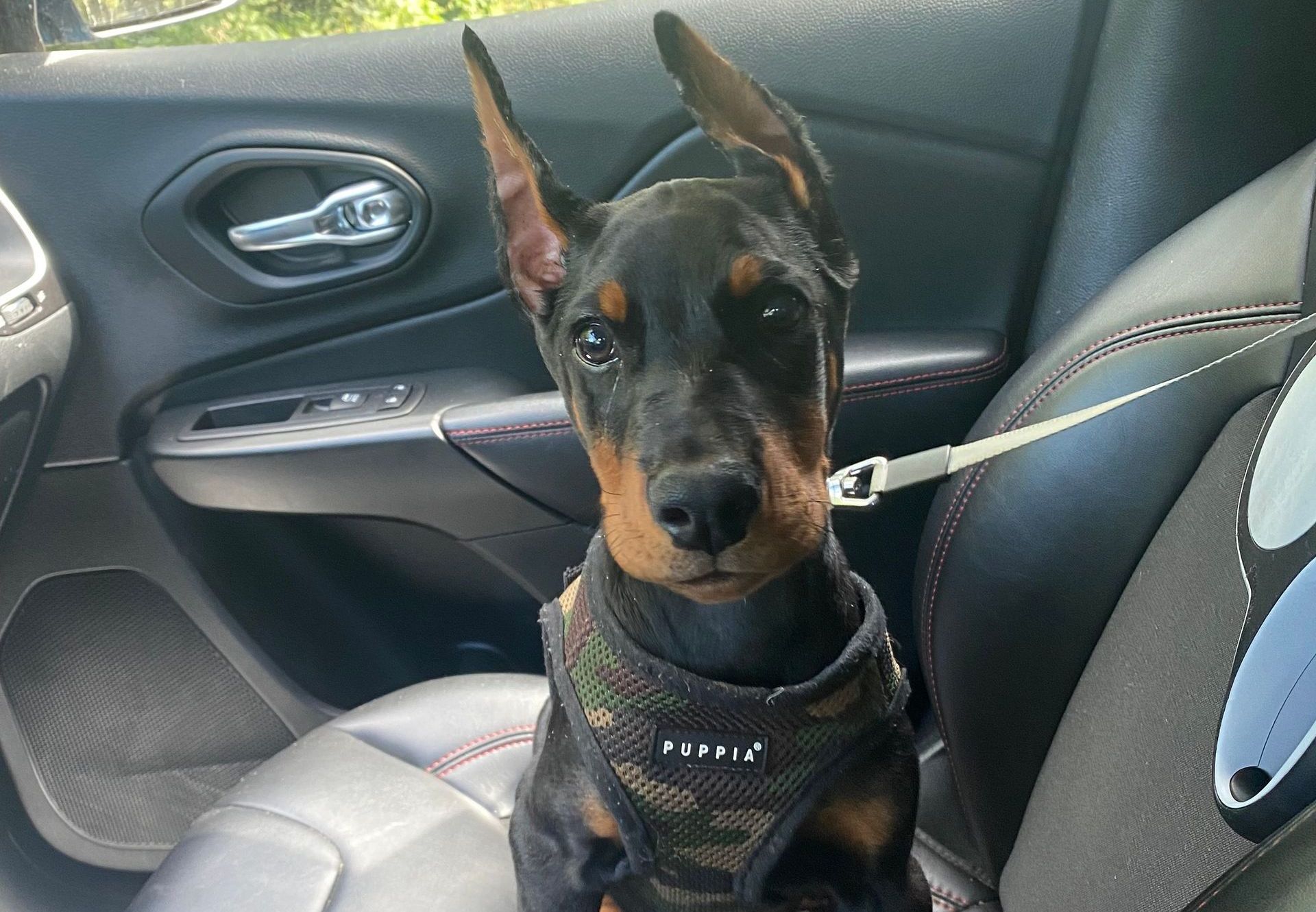

puppy socialization classes held, it is a free for all and you have to question what your dog is actually learning. The chances of a bad experience are just as likely as a good one. Many people take their dogs to dog parks and I find that to be more dangerous than helpful, I cannot begin to tell you how many horrible dog park experiences I have heard. I believe if you are interested in doing this type of socialization the interaction must be controlled and have no more than 2 dogs at a time.
Until you are confident in both dogs, they should remain on loose leads. People also need to understand that by the time we get our puppies (usually 8 - 12 weeks) they have learned a great deal on dog communication from their litter mates. Also, does it really matter that our dog doesn't get along with random dogs? I've always been fascinated by peoples obsession on this topic of dogs having to get along with random strange dogs.
If we teach our dogs to go up to strange dogs its not only dangerous; but teaches our dogs to be distracted and to ignore us. So overall, as far as this type of socialization goes, I recommend doing it if you are going to have multiple dogs and if you do it controlled and safely, otherwise I wouldn't bother. If you own only one dog I suggest getting your puppy used to your daily life.
Recently I got a westie puppy used to a vacuum cleaner, here is how I went about this process: first, I started by just introducing the vacuum in the room with the puppy, the vacuum was not on or moving. Every time the puppy explored the vacuum I would mark and reward (check out my article on marker training for details on how to marker train), eventually I had the puppy eating off of the vacuum.
The next step was to start moving the vacuum, the puppy backed away when the vacuum was moving so I started rewarding her where she was comfortable and slowly got closer to the vacuum. I did the same thing after I turned it on. The process must start with simplest version of what you are introducing, then made more and more difficult. This is important to prevent overwhelming the dog right off the bat. You can do this process with anything.
The next style of socialization is to take your dog around distracting things like other dogs or people, but only reward them when they are paying attention to you. This eventually teaches your dog to not pay attention to distractions in their environment, and also simultaneously builds good associations to the distractions you are around. Is it more important for our dogs to focus on us and listen to us, or get along with every dog in the neighborhood?
Overall all three types have benefits, it really all depends on what you are looking for. Personally, I prefer my dog to focus on me and tune everything else out. The new dog and the established dog. These are tricky waters to navigate for dog owners. As with many scenarios in dog training the best of intentions can turn into a big problem in a hurry. Dog owners can just be trying to give their dog a friend or be trying to give their kids a younger more energetic dog as their current dog ages.
The first mistake people make is assuming that their older dog is "nice" so there shouldn't be any issues. The second mistake is assuming it's the older dog's responsibility to deal with the new dog. As with any interaction whether it's between two or more humans or two or more dogs the "nice" one can still be targeted. You can be the nicest person in the world and get stuck around a bully twice your size and have lots of problems.
Or just be around someone who is very annoying to you and you just lose your patience. It always takes at least two to tango. Now your new dog or puppy may not be trying to be mean, they could simply be over excited, have no off switch, not understand how to appropriately play yet etc. Your older dog can simply be telling your new dog to stop or to go away from them. Learn to read your dogs and learn when to step in. The vast majority of older dogs are not trying to seriously injure your new dog.
Dogs use body language and different vocalizations to communicate with us and each other. Most of the stuff that looks bad to the untrained eye in these situations are actually called agonistic behaviors which means behaviors used to create space between dogs that are annoying or potentially threatening. We should be seeing the signs before it gets to the point of air snapping, growling, showing teeth or biting though. We should step in and advocate for our older dog from day 1.
When you see your new dog demand barking at your older dog to play, jumping on your older dog, acting obsessed with your older dog, getting to close when your older dog is eating or chewing a bone etc you should be intervening before your older dog feels like they have to. I personally use spacial pressure, squirt bottles and dressage whips ( used as an extension of my arm, not as a whip) to separate dogs and provide space for my older dog.
It is also our job not our older dog's job to teach our new dog how to behave. Until you know your dogs are safe together I never suggest leaving them alone together. Always use crates, gates or exercise pens to keep them separated when they are unsupervised. Having both dogs obedience trained is crucial, but until they both respond well they need to be managed. Cues that are helpful in these situations are the place command, come when called, wait, boundaries and relaxation.
Most often we have to start with teaching our dogs to just learn how to exist around each other before they can learn to accept and like each other. Management is crucial in the beginning as well as having good things like small training sessions occur near each other and going on walks together. I also recommend picking up all toys and food dishes at least until the dogs become more comfortable with each other.
WORKING AT APPROPRIATE LEVELS The idea of being at a certain skill level and labeling it isn't a new concept. We obviously have different grade levels throughout school, different ranks in professional sports, different belt colors in martial arts and different ranks throughout corporate jobs. This concept as logical and common as it with humans is almost always completely lost when it comes to training our dogs.
In general what dog owners do to teach dogs to stop doing something is put them in a scenario they can't handle or are not ready for and then teach the dog a lesson through corrections in that very moment. Though most people want to put forth the least amount of effort, money and time in to training their dogs, quality of training should not have to suffer due to human laziness. Instant gratification and the learning process are not easily aligned.
Most people would agree that a human is smarter than a dog- (we are or dogs would be running the world... )Think of how long it takes to truly master things even for us more intelligent humans. We go through 12 years of school just to make it to college and another 2 - 8 years to graduate with a piece of paper that says we are capable to do our chosen professions.